


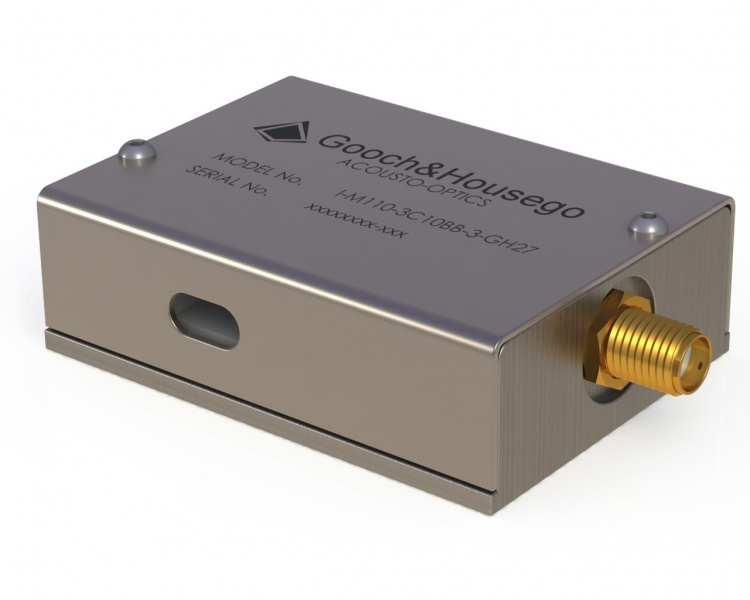
Acousto-Optic Modulators (AOM)
Gooch & Housego
|
如果您對AOM的產品規格不熟悉,請您點擊以下連接填寫 AOM-Q&A表單,我們會盡快為您提供更多的相關資訊。 |
Modulators allow the intensity of light to be controlled and modulated at rates that far exceed mechanical shutters. Our acousto-optic modulators are optimized for low scatter and high laser damage thresholds.
For fiber coupled acousto-optic modulators, visit our Fiber-Q fiber coupled modulators page.
In order to identify the best acousto-optic modulator and RF driver solution, the key trade-off parameters to consider are the rise time, modulation rate, beam diameter, and optical power handling.
Optimized acousto-optic modulators
The most important factor in selecting a modulator is the required speed. This influences the choice of material, modulator design, and RF driver to be used.
The speed of a modulator is described by the rise time, which determines how quickly the modulator can respond to the applied RF driver and limits the modulation rate. Rise time is proportional to the time required for the acoustic wave to traverse the optical beam and for this reason, is influenced by the beam diameter within the modulator.
Modulators fall into two general categories as regards speed. Very fast modulators can provide modulation frequencies up to 200 MHz and can have a rise time as low as 4 ns. The input beam must be focused very tightly into the modulator to achieve this speed. Lower frequency modulators do not have this constraint, however, and can accept larger input beams. Their rise time is usually specified relative to the input beam diameter, in ns/mm.
If you require either fast repetition rates or large aperture sizes, our acousto-optic modulators are optimized for low scatter and high laser damage threshold, for reliable operation in a wide range of applications.
In order to identify the best acousto-optic modulator and RF driver solution, the key trade-off
parameters to consider are the rise time, modulation rate, beam diameter, and optical power
handling.
Optimized acousto-optic modulators
The most important factor in selecting a modulator is the required speed. This influences the
choice of material, modulator design, and RF driver to be used.
The speed of a modulator is described by the rise time, which determines how quickly the
modulator can respond to the applied RF driver and limits the modulation rate. Rise time is
proportional to the time required for the acoustic wave to traverse the optical beam and for this
reason, is influenced by the beam diameter within the modulator.
Modulators fall into two general categories as regards speed. Very fast modulators can provide
modulation frequencies up to 200 MHz and can have a rise time as low as 4 ns.The input beam
must be focused very tightly into the modulator to achieve this speed.Lower frequency
modulators do not have this constraint, however, and can accept larger input beams.
Their rise time is usually specified relative to the input beam diameter, in ns/mm.
If you require either fast repetition rates or large aperture sizes, our acousto-optic modulators
are optimized for low scatter and high laser damage threshold, for reliable operation in a wide
range of applications.
Acousto-Optic Modulators (AOM)
|
Product |
Wavelength |
Rise / Fall Time |
Active Aperture |
Operating Frequency |
Optical Material |
Type |
|
I-M110-3C10BB-3-GH27 AOM |
300 - 400 nm |
113 ns/mm |
3 mm |
110 MHz |
Crystalline Quartz |
UV |
|
I-M110-2C10B6-3-GH26 AOM |
400 - 540 nm |
113 ns/mm |
2 mm |
110 MHz |
Crystalline Quartz |
Visible |
|
I-M0XX-XC11B76-P5-GH105 |
5.5µm |
120 ns/mm |
9.6 mm |
40.68 - 60 MHz |
Germanium |
N/A |
|
I-M080-2C10G-4-AM3 AOM
|
1030 - 1064 nm |
113 ns/mm |
2 mm |
80 MHz |
Crystalline Quartz |
IR |
|
I-M050-10C11V41-P3-GH75 |
9.4µm |
120 ns/mm |
9.6 mm |
40/60 MHz |
Germanium |
Mid-IR |
|
I-M041-XXC11XXX-P5-GH77 |
10.6 µm,9.4 µm |
120 ns/mm |
11.6 mm |
40.68 MHz |
Germanium |
Mid-IR |
|
I-M041-2.5C10G-4-GH50 AOM |
1030 - 1064 nm |
113 ns/mm |
2.5 mm |
40.68 MHz |
Crystalline Quartz |
IR |
|
AOMO 3200-125 |
470 - 690 nm |
160 ns |
1.5 x 2.5mm |
200 MHz |
Tellurium Dioxide |
Visible |
|
AOMO 3200-124 |
780 - 850 nm |
10 ns |
0.32 mm |
200 MHz |
Tellurium Dioxide |
IR |
|
AOMO 3200-1220 |
257 nm |
10 ns |
0.25 x 2.5mm |
200 MHz |
Crystalline Quartz |
UV |
|
AOMO 3200-121 |
515 - 633 nm |
18 ns |
0.32 nm |
200 MHz |
Tellurium Dioxide |
Visible |
|
AOMO 3200-120 |
442 - 488 nm |
13 ns |
0.45 mm |
200 MHz |
Tellurium Dioxide |
Visible |
|
AOMO 3200-1113 |
1047 - 1060 nm |
10 ns |
0.1 mm |
200 MHz |
Tellurium Dioxide |
IR |
|
AOMO 3110-197 |
1047 - 1060 nm |
18 ns |
1.25x 2.5 mm |
110 MHz |
Tellurium Dioxide |
IR |
|
AOMO 3110-121 |
442 - 488 nm |
18 ns |
0.6 x 2.5mm |
110 MHz |
Tellurium Dioxide |
Visible |
|
AOMO 3110-120 |
440 - 850 nm |
18 ns |
0.6 mm |
110 MHz |
Tellurium Dioxide |
Visible |
|
AOMO 3100-125 |
440 - 850 nm |
160 ns |
1.5 mm |
100 MHz |
Tellurium Dioxide |
Visible |
|
AOMO 3080-125 |
415 - 900 nm |
25 ns |
2 mm |
80 MHz |
Tellurium Dioxide |
Visible |
|
AOMO 3080-122 |
780 - 850 nm |
25 ns |
1x 2.5 mm |
80 MHz |
Tellurium Dioxide |
IR |
|
AOMO 3080-120 |
440 - 850 nm |
34 ns |
1 mm |
80 MHz |
Tellurium Dioxide |
Visible |


|
如果您對AOM的產品規格不熟悉,請您點擊以下連接填寫 AOM-Q&A表單,我們會盡快為您提供更多的相關資訊。 |
相關產品
.JPG)
(2).JPG)
.JPG)
雷射相關資訊
-
2014 台北國際光電週- 國際光電大展 06/17(二)~06/19(四)
2014年台北國際光電週- 國際光電大展展期期間為 06/17~06/19 (週二~週四)敝司將於

-
2017 台北國際光電大展 06/14(三)~06/16 (五)
2017台北國際光電大展將於台北世貿南港展覽館一樓盛大展出展出期間為:06/14 (三)~06/16
-
雷射焊接之原理與優勢
雷射焊接之原理與優勢認識焊接的基本原理、雷射焊接的技術優勢與產業應用 01 什麼是焊接?焊接 Wel
-
雷射切割應用與選型:從光纖雷射、CO2雷射到智慧切割頭
雷射切割怎麼選? 金屬板材通常以光纖雷射為主要方向;壓克力、薄膜與部分非金屬材料可評估 CO2 雷射